□□□
Experience defines us. In 1987 I went with my father to see Platoon in the theatre. I was thirteen. I was gung-ho, to say the least, about the military and about anything to do with the United States war in Vietnam. I was thirteen.
It suffices to say, I thought Platoon was the cat's ass. More important, is what I remember from
that night. When the movie ended, nobody got up; the theatre was devoid of
human noise. When the credits finished, the screen went blank and the house
lights came on. Silence. I can't say how many minutes passed until someone left,
but we all did. I had never seen an audience react to a movie that way before
and I haven't seen it happen since. We were dumbfounded. I was thirteen.
□□□
 The first issue of The
'Nam was published by Marvel in December 1986, right about the same time Platoon was released in theatres. Again, Marvel EIC
Jim Shooter was (is?) one magnificent bastard when taking the pulse of the
proletariat. Written by and edited by Vietnam War veterans, Doug Murray and
Larry Hama, respectively, The 'Nam
plays as a soldier's story from men who, in real life, walked point and served
in country. The series hook was that it was told in real-time; a reality-based
comic book that followed in the footsteps of real events -- the thirty days
between issues represented thirty days in the tour of PFC Ed Marks, the main
character and audience surrogate. No politics, no swearing, no drugs, no larger
social context and no agenda. Murray uses The
'Nam to examine how war affects the soldiers themselves, a comic book as
history lesson.
The first issue of The
'Nam was published by Marvel in December 1986, right about the same time Platoon was released in theatres. Again, Marvel EIC
Jim Shooter was (is?) one magnificent bastard when taking the pulse of the
proletariat. Written by and edited by Vietnam War veterans, Doug Murray and
Larry Hama, respectively, The 'Nam
plays as a soldier's story from men who, in real life, walked point and served
in country. The series hook was that it was told in real-time; a reality-based
comic book that followed in the footsteps of real events -- the thirty days
between issues represented thirty days in the tour of PFC Ed Marks, the main
character and audience surrogate. No politics, no swearing, no drugs, no larger
social context and no agenda. Murray uses The
'Nam to examine how war affects the soldiers themselves, a comic book as
history lesson.  As a thirteen-year-old comic book reader, The 'Nam changed me. I was
never tied to the superhero set, when others write about a deep abiding love
for a particular superhero or superhero team; I often nod and play along. I'm
not struck on a certain genre either. The 'Nam
is a 'war comic,' but that's circumstantial. I'm
not (much) of a slice-of-life-comics guy either or a history buff. I'm more …
chaotic neutral, idiosyncratic, a pain-in-the-ass. The 'Nam wasn't like other comics
because, to me, it was serious,
grown-up and there is nothing a thirteen-year-old wants than to be
grown-up.
As a thirteen-year-old comic book reader, The 'Nam changed me. I was
never tied to the superhero set, when others write about a deep abiding love
for a particular superhero or superhero team; I often nod and play along. I'm
not struck on a certain genre either. The 'Nam
is a 'war comic,' but that's circumstantial. I'm
not (much) of a slice-of-life-comics guy either or a history buff. I'm more …
chaotic neutral, idiosyncratic, a pain-in-the-ass. The 'Nam wasn't like other comics
because, to me, it was serious,
grown-up and there is nothing a thirteen-year-old wants than to be
grown-up.
When I
think of The 'Nam, I think of the
saucer-sized eyes, the backwards cap, the army flashlight and .45 on the front
of issue #8 and it scares the fight right out of me. Artist Michael Golden
captures the absolute expression of dread and fear on the face of that soldier;
it's a chilling look of desperate determination. Golden did the cover art as
well as the interiors for the first year the series was in publication. At the start of its run, each issue of The 'Nam was a stand-alone story. The series did not
feature cliffhanger endings or follow continuity within the Marvel Universe (or
the New Universe, for that matter). Later on in the series (after writer Doug
Murray left) in an act of editorial hubris -- and to boost flagging sales -- the
Punisher was brought into the series continuity in something called The Punisher Invades The 'Nam. Truth is
sometimes stranger than fiction.
The 'Nam #8 follows
SP5 Frank Verzyl, a ''tunnel runner''
(later called 'tunnel rats') -- on the letters page of each issue (entitled 'Incoming')
Murray includes notes and definitions for terms used in each issue. Since the
1940's, the Viet Cong had been constructing underground complexes that
contained hospitals, headquarters, storage facilities and much more. The
tunnels were narrow and suffuse with booby traps. It took temerity to build
them and balls to go down into them in pursuit of the enemy.
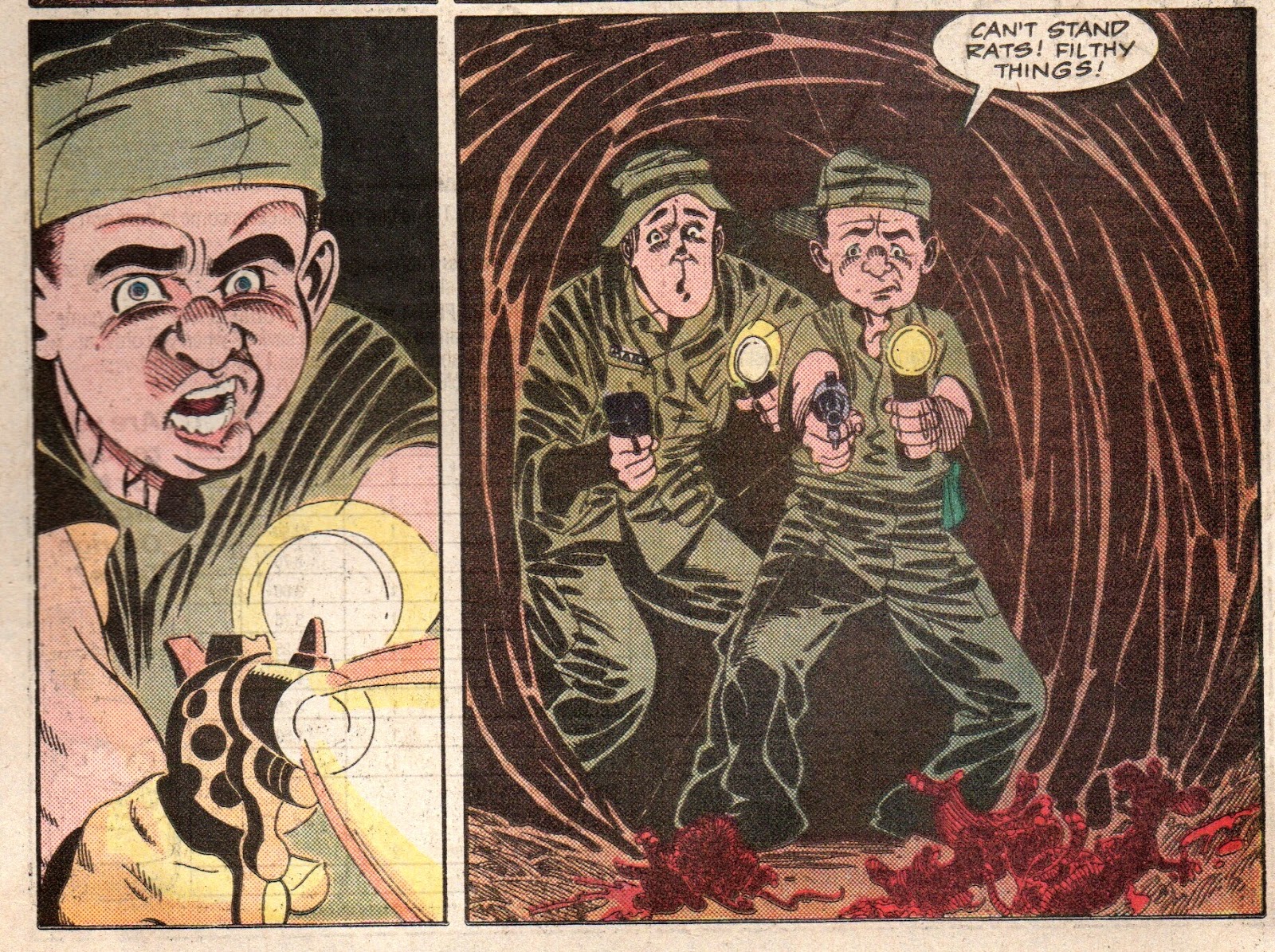 Golden's cartooning is known for its detail and realism,
it's reminiscent of Hal Foster, Bill Mauldin and Will Eisner. For the design of
Verzyl, Golden comes up with a very
cartoonish look; at times, the soldiers in The
'Nam look like the Riverdale gang in olive drab and Verzyl that much more, which is Murray and Golden's point. Verzyl's nose sticks out to me; it looks
like a teardrop whereas the noses of the other characters all cut a similar
straight line, cartoonish, yes, but Verzyl's schnoz looks more exaggerated by
design. By giving Verzyl a more stylized appearance, Golden tempers the tension
in the issue. In fact, Verzyl looks a bit like Elmer Fudd (more on that in a
moment) a little too on the nose, perhaps, but Golden and Murray's hearts are
in the right place.
Golden's cartooning is known for its detail and realism,
it's reminiscent of Hal Foster, Bill Mauldin and Will Eisner. For the design of
Verzyl, Golden comes up with a very
cartoonish look; at times, the soldiers in The
'Nam look like the Riverdale gang in olive drab and Verzyl that much more, which is Murray and Golden's point. Verzyl's nose sticks out to me; it looks
like a teardrop whereas the noses of the other characters all cut a similar
straight line, cartoonish, yes, but Verzyl's schnoz looks more exaggerated by
design. By giving Verzyl a more stylized appearance, Golden tempers the tension
in the issue. In fact, Verzyl looks a bit like Elmer Fudd (more on that in a
moment) a little too on the nose, perhaps, but Golden and Murray's hearts are
in the right place.
Snakes have it rough in The
'Nam #8. A big python has its head blown off on the first page and then a
poisonous bamboo snake is tricked out of a trap and decapitated -- that's world
building in The 'Nam, kill or be
killed. Claustrophobics will have a tough enough time with this story, but Murray
has to make sure the stakes are set high and the danger is palpable. The tunnel
entrance is discovered within the first couple of pages. Verzyl is called in
and another soldier, Marty, is sent down first to assist him. Marty makes it
one panel before he screams and a bloody mess that was Marty gets pulled out of
the hole. Marks and his best friend, Mike, grenade the hole and the threat
abates, for now. The NCOs (non-commissioned officers) and the officers confer
and ask for another volunteer, Marks steps up and goes down into the tunnels
with Verzyl.
Golden never gets flashy with his panel layouts. He divides
his pages into five or six panel grids which gives The 'Nam the look and feel of a documentary or a news report -- the
US war in Vietnam was, after all, the first war to be broadcast. The larger
size panels allow Golden to cram his compositions. Some part -- a boot, an arm,
or a head – of Marks or Verzyl always crowds the space he shares with his
partner. To further add to these tight quarters, Golden employs several
close-ups and gets right up into the faces of the characters, sometimes his
focus is so tight, only an eye fills the frame and sometimes it's the booby-trapped
belly of a corpse.
Verzyl (at his most Fudd-like) pops out of the ground at the
end with his arms raised above his head and says to the four muzzles that cover
him: ''American! I'm an American! Apple
pie, the World Series, oh, say can you see! Don't shoot'' With the Verzyl
and Marks out from the underground, Verzyl tells Marks his time in Vietnam is
getting short. He wants to ''re-up and go
airborne. Get some extra money and get out of the mud.'' Marks responds
with the issue's most poignant and most disturbing line: ''Won't do any good. There's [sic] tunnels all around here. All over the place.'' That's the thing
about war, about The 'Nam, success is
a fallacy -- there are always more
tunnels, missions end; war endures.
What would become The
'Nam began as '5th to the 1st,'
which Murray and Golden created and was featured in the short-lived (Oct. 1985 - Dec. 1986) black-and-white
Marvel anthology, Savage Tales. Only
two of those stories, '1967 ' and 'The Sniper' were published in Savage Tales. '5th to the 1st: The
Tunnel Rat' serves as a backup story in The
'Nam #8. Verzyl is again the main character, but the story is presented as
a mix of panels and full page illustrations (very similar to Foster's Prince Valiant). There are no word
balloons, only text boxes that read as journal entries. The plot is basically
the same, an entrance to a tunnel network is discovered and Verzyl is sent in
to investigate.
 'The Tunnel Rat' has little to none of The 'Nam's sensibilities when it comes to the horrors of war. In
many ways, 'The Tunnel Rat' has more in common with Two-Fisted Tales or even Sgt.
Rock by way of H.P. Lovecraft and E.A. Poe than it does with The 'Nam. While underground Verzyl is
attacked by dozens of rats. Golden draws three widescreen panels and stacks each
on top of the other as Verzyl is overrun. The middle panel is askew as the
camera zooms in on the Verzyl's terror-filled face. The bottom panel is devoid
of emotion or expression; it is solid black and slanted. Golden and Murray know
they can't express or show a greater horror than what the reader's imagination
will fill-in for that final panel.
'The Tunnel Rat' has little to none of The 'Nam's sensibilities when it comes to the horrors of war. In
many ways, 'The Tunnel Rat' has more in common with Two-Fisted Tales or even Sgt.
Rock by way of H.P. Lovecraft and E.A. Poe than it does with The 'Nam. While underground Verzyl is
attacked by dozens of rats. Golden draws three widescreen panels and stacks each
on top of the other as Verzyl is overrun. The middle panel is askew as the
camera zooms in on the Verzyl's terror-filled face. The bottom panel is devoid
of emotion or expression; it is solid black and slanted. Golden and Murray know
they can't express or show a greater horror than what the reader's imagination
will fill-in for that final panel.
The rats are bad, but what happens next is worse. Like the
undead, Verzyl comes tearing out of the ground. Wild-eyed, he fires his pistol
back into the hole he just emerged from and then falls into a fetal position.
He's in shock. On the next page, the narrator explains that Verzyl was
beginning to pull himself together when a callow lieutenant orders him to go
back down into the tunnels. The narrator explains what happens next: ''Fudd did the only thing he could think of --
he pulled his sidearm and shot the LT on the spot.'' The story ends with
Verzyl court martialed, strapped to a gurney and put on a transport plane -- ''a raving madman.'' Golden uses three
panels to show Verzyl's approach to the plane. The first and second panels look
out from the ramp of the C-130, the third panel is from Verzyl's POV as he
looks up at, says the narrator: ''the
biggest, blackest tunnel mouth you've ever seen.'' Verzyl loses whatever
sanity he has left. The final panel is a close-up of his face, a rictus of pain
and terror. The narrator says: ''I still
hear that screaming sometimes in my head […] sounds kind of stay with you.''
Verzyl's fate is sensational in extremis. The first story, 'In the Underground,' has a higher
body count, but because of Murray and Golden's comics-code-friendly approach to
the storytelling it feels more sanitized, more of an adventure. 'The Tunnel Rat'
has none of that. Perhaps it's Golden's more realistic approach to the art or
Murray's use of a third-person narrator that makes 'The Tunnel Rat' feel more
like a horror of war rather than a
look at the horrors of war. Like
Verzyl, it's the cargo bay door that haunts me too, a black maw opening into
nothingness and into inescapable madness.
□□□
My own hawkish-ness would subside in the years to come --
four years at a military college gained me both a healthy respect for those who serve and the good sense military service wasn't for me. I've also seen
Platoon several times since and, yes,
it holds up.
Comic books will always have to push back against those who
see them as merely 'comic books,' escapist fare for puerile thirteen-year-olds
and neither serious art nor capable of commenting on the human condition. The 'Nam proves otherwise. Its creators use
their experiences during wartime to teach a new generation about what it means
to be human under extreme and oftentimes absurd conditions.
In the mid-1980's, comic book writers and artists establish
a beachhead towards acceptance in popular culture. The Dark Knight Returns and Watchmen
provided a kind of cultural clout the mainstream is only catching up to
today. The 'Nam isn't as well-known
as either of those two other works. It is significant for what a comic book can
do and for that alone, The 'Nam should
be remembered.


