Showing posts with label Keith Silva. Show all posts

Friday, October 30, 2015

Interrogative Mood [reprise]: RAV (1st Collection)

Cartoonist: Mickey Zacchilli
Publisher: Youth in Decline
 

Does a line like, ''And I'm taking the motherfucking Lesabre'' fill you with curiosity, make you laugh or give you pause? How do you cope with chaos in life? What about in art? Do you find mayonnaise a suitable sandwich spread? How much risk should a comic take? Should RAV be enough, title-wise? Would it read better as an acronym? Really Awesome Velocipede? Republicans Against Vaginas? Reread After Viewing? Would your inner-obsessive experience the howling fantods to read Mickey Zacchilli's advice in the introduction to RAV 1st Collection that she would prefer that the reader not ''hunt down RAV #1 […] because it wasn't very good so it got flushed?'' Can a comic or a 1st collection of a series of comics be incomplete? Is Zacchilli trustworthy? Believable?

If a boy asks you to go to a graveyard and make out, do you? What if his name is 'Juice' and he smokes cigarettes and never takes off his sunglasses, even at night, even in graveyards? What if, instead, his name was Snake Prince Edward and he asks to share a booth with you at the IHOP? How much graveyard-making-out leads to graveyard-sex or graveyard-handjobs? Do you enjoy the smell of your shampoo? Why is Rolo always smiling? What's he know that Juice and Rolo's boss, Ben, don't know? Do you think of the smile as a contagion? What about rage? Have you ever given in to the urge to run down the aisle in a grocery store and knock items off the shelf? How often have you gone 'commando' at work? Do you own pinking shears? When did comics become so corporate or have they always been corporate and it's only now they've become less so and therefore more risky? Two-hundred-and-ninety words in, how would you assess your level of boredom so far? Should I go on? Do you recall the first time I tried such a rhetorical device?

How do you acquaint yourself with unfamiliar words like 'shōjo' or 'josei' in reviews of comic books? Now—and from context you can probably guess at the next question—what if these words precede the word 'manga'? Do questions about Manga make you feel sheepish or do you bluff? Does a similar reaction occur when someone confronts you with a word like 'risograph'? Have you ever experienced motion-sickness? Is it spinning that turns your guts to water, abrupt changes in air pressure, how about S-curves on secondary roads, all three? When you ride in a car and a fellow passenger says they are 'car sick' and you are not, do you a feel a sense of superiority or empathy? Are you aware a cat's kidneys can process sea water?

When someone you know only tangentially like a co-worker's brother or the assistant pastor at the church your neighbor attends who has been invited to the neighbor's son's sixth birthday party for reasons you glean are political or the barber who's covering for the guy who usually cuts your hair and everyone calls 'Brother' even though he's an only child makes the joke, 'what's the difference between in-laws and outlaws?' and delivers the punchline without the common courtesy to include you, in this instance, do you wish they had just ripped a loud dog-like fart and been done with it? What's the proper etiquette when someone says 'something suddenly came up?' Where do you stand on the issue of fair-trade coffee? If it were a question of fair-trade cocaine would your opinion change? Do you have a prepared answer to the question: 'What's the best depiction of an orgasm you've ever witnessed secondhand?' Does all of this change once you open RAV to find all the pages are butterscotch yellow?     

Where was I? Did you know Mickey Zacchilli is a woman? Does it matter? Does knowledge of Zacchilli's gender increase your interest in RAV? Are we more obsessed with gender now than previous generations or is it because before people were more willing to paper over phrases like 'gender issues' with other phrases like, 'everything's going to hell in a handbasket' or 'mind your own fucking business'? When a critic refers to an artist as a cartoonist does it seem pretentious or an honest stab at accuracy? Can you make a good faith judgement, yay or nay, when, in issue #5, Juice receives a kitten from Main Marian—who, this time around instead of being naked and at home with drenching her pussy in milk, is wearing clothes and sporting a fluffy hat—as to if Juice is capable of taking care of said kitten? How do you think Sally's going to react when she finds out about a strange women with a penchant for sodden sex organs is handing out free-of-charge kittens to the guy who considers her [Sally] his 'lady'? Is the mishigas over the hatred for the word 'moist' overblown? Did you know Adolf Hitler and Ludwig Wittgenstein were classmates? Are you still thinking about graveyard handjobs? When Ben sends Juice to look for Sally in the Meat Cave, in the context of the narrative, is it considered a ruse, a red herring or a straight-up lie, neither? Have you ever bought duty-free Toblerone? Which word appeals to you the most: 'diecast,' 'kneeler,' 'distaff,' 'shopworn,' 'hobnail,' or 'Spider-Man'? How often do you consider your own breathing? Do you still pine for the Intellivision?             

If you've gone this far, why not just a bit more? Have I left enough breadcrumbs to follow, so to speak, to figure out what RAV might be about? Do you consider 'plot' a sacred trust? Is it asshole to think all these questions are a viable or valuable assessment when it comes to interrogating RAV? If cartoonists like Zacchilli make readers consider the possibilities of comics—how a comic work best when its only classification is as a comic and not this or that kind of comic—doesn't that render the story and the characters moot? Or is it the other way around, only because the adventures of Juice, Sally, Kitten, Ben, Rollo, Main Marian and Snake Prince Edward are so tied up in relatable actions like talking and the joys and pitfalls of relationships that RAV is so relatable and a comic worth your time?  Would you take the ''motherfucking'' Lesabre? Is this enough? Too much?
 

Saturday, May 16, 2015

On the Road: A review (of sorts) of Space Riders #2

W: Fabian Rangel Jr.  A: Alexis Ziritt L: Ryan Ferrier P: Black Mask

Dedication: For Sal and for Dean and black coffee

I first met Fabian Rangel Jr. and Alexis Ziritt’s Space Riders not long after my wife and I split a delicious crepe drizzled with honey and walnuts and stuffed with ricotta. I had just read another duller than the dullest dull corporate comic I won’t bother to talk about, except it had something to do with some miserably weary ‘secret’ something and my feeling that everything about superheroes i.e. corporate properties nowadays really does make me feel dead inside. With the coming of Space Riders began the part of my life you could call my life on the road to gutters filled full with faux smudges, ersatz water stains and all Ziritt’s phantasmagorical ribbons of red, orange and green exploding like spiders across the stars and all that crackle, crackle, crackle; and Rangel Jr.’s tale of an anthropomorphized mandrill first mate by name of Mono, Yara whose half Fritz Lang and half Hajime Sorayama and all hip-swinging-karate-kicking gynoid and, course, Capitan Peligro, a dangerous sort, duh, the son of the “toughest son of a bitch in the galaxy,” wielder of the Ghostmaker and enemy to Vikers and space whalers everywhere. Whither goest thou, Capitan, in thy tiny shiny skull ship, thy Santa Muerte in limitless space as black as the morning’s coffee as “black and [as] infinite?” Where goest thou? Space Riders #2 proves one-eyed beardy boys and green-skinned-magenta-haired alien warrior girls with Genesis-era-Peter-Gabriel-style makeup in America and across all the universe have such a sad time together when they must part because he’s a Space Rider and she’s a wizard; but oh, my dingledodies, my mad ones, that kiss, that kiss, that kiss they share it burns, burns, burns in madder red and salient saffron, her hand on his hirsute cheek, their lips in ferocious symmetry of questions unanswered—EE-YAH! EE-de-lee-YAH! Ey-y-y-y-y-es—oh Donna Barbara you space wizard and speaker of Enna-ish, you, you protectress of strange wonderful tribal creatures of wherever. Rave on. Rave on. Rave on! Rangel Jr. is the HOLY GOOF, a con man of comics who writes like an old tea-head of time. See how he takes what’s in those old musty dusty moldering stacks of memories and youthful indiscretions so fraught with the efforts of the imagination injection machine, the ones found in four color panels and now only safely held by the white cotton gloves of some sub-sub-sub-librarian in basements and morgues? You know, all the ones to Flagg, those old serials filled with head hurling super wizards and mystery woman of the jungle, right (?) the one with the bedroom eyes who becomes the fearsome and not-to-be-fucked-with skull-faced Fantomah? How he, I’m talking about Rangel Jr. here, loops and grooves and riffs to create the mimesis of mimesis of the infinite? See how he stands astride the heaps of pulpy comics stacked like cordwood, stands there with outstretched palms hovering over keyboard like those old monks in their cells with ink pot and pen who stave off ‘the’ plague as they bend to their illuminated manuscripts? Rangel Jr. wrestles this vortex of madness to a draw enough so as to let it live on its own. He does not tame, he acts and encourages and all that stuff, stuff, stuff that wonderful stuff is his medium. With him it’s all “sure, baby, mañana,” and I shamble after as I’ve been doing all my life after writers and madmen who interest me, on to the next issue, the next fix— mañana, a lovely word and one that probably means creator-owned comics. And Ziritt? Ziritt is a God lashed to the drawing table or the cintiq undulating through the infinite like great an-anu herself in all her dreaming, her munificence. Those thick ink lines so supple they roll and roil like the Susquehanna in the wilderness of the American spring. Ziritt’s pencils, inks and colors are, as Yara puts it about a ship the crew encounters, a ship, a space station of sorts, perhaps, in the shape of a seated robot like great wise Solomon himself, a robot composed of all the best parts of Force Five -- Grandizer, Gaiking and Dangard Ace -- Yara sez, “that design … is beautiful.” Here is a cartoonist who knows what he likes. Ziritt’s figure work looks like the drawings of that one kid in high school who would fill pages upon pages of blue-ruled notebook paper with space ships, astronaut guys, and aliens with skulls encased in helmets or with the heads of wolves or pyramids while I wept for that seer and pig-palaver-ist Simon, killed by machismo, chaos and sharp sticks. I always envied those talented kids, kids like Ziritt who could slip the bonds of High School English class and light out for worlds of their own non-Lucas-ized imagining. Ziritt brings Space Riders its intestinal fortitude, its balls. Those fools of consistency and continuity, those hobgoblins of little minds who take the name of Kirby in vain as if it’s some truth-telling device, some test, a buffet the enlightened use to wave away whatever bits of golden age knowledge crosses their transom. Oh those sad, sad-eyed fanboys who will never understand … Ziritt does not draw for them or for Jack Kirby or for the heavy holy trinity of Maroto, Moreno and Lindell … he draws for himself, for Ziritt. So in America when the “class 5 tractor beam” pulls us all into the mouth of a giant seated robot spaceship-thingy and I sit at the old broken-down re-purposed cubicle watching the long, long lines of MCU sheep at the Cineplex and sense there is something more in all the primary color and paper that rolls onto the shores of the LCS week-to-week in one unbelievable huge bulge we call Capital-C Comics, and all that road going, all the people dreaming in the immensity of it, of comics and what they hold, and don’t you know that God is Pooh Bear, and ol’ Rangel Jr. and Ziritt? and nobody knows what’s going to happen next to our heroes now captured by those robots with their glowing green wire-frame heads and smoke streaming from round eyes like newly made bullet holes, I think of Space Riders, I even think of old Hammerhead the first mate we haven’t found (yet) I think of Space Riders.

---

Space Riders #2 is available May 13 at fine retailers in America and elsewhere. Space Riders #1 and #2 can also be procured in both physical and digital manifestations direct from Black Mask Studio.

Keith Silva rereads On the Road in what Eliot sez is the cruelest month. He writes about comics and pop culture. Such endeavors have made him an inveterate caffeine addict with an increasing taste for stronger vices like Kentucky bourbon and single malt scotch. He does not need his hand held unless it’s by his wife or daughters. @keithpmsilva

Saturday, December 13, 2014

Peter Pan Collars Don't Lie: The Deceptive Simplicity of Operation Margarine

Cartoonist: Katie Skelly
Publisher: AdHouse Books

Katie Skelly knows her way around exploitation: what to show, who not to cover up, where to put the accents, when to be bold and how much of each. Her 2012 debut graphic novel, Nurse Nurse, was a tease in all the best ways, a goofy nitrous high of see through strips held together by a barely there narrative, but the charm, oh, the charm. Skelly’s characters possess all the pathos of Shultz’s Peanuts with the charisma of a Daniel Clowes or a James Kochalka oddball. Operation Margarine sees Skelly pin the needle to the right and give a throaty roar of a creator in full.   

The lives of bad good girl Margarine (sounds like bombazine or aubergine) and bad ass Bon-Bon have become dead ends, or worse, cul-de-sacs. Margarine is a society gal (Claudette Colbert in It Happened One Night wearing Mia Farrow’s pixie cut from Rosemary’s Baby) fresh from a recent breakout from a psych ward, Bellefrew. Bon-Bon bears the scars of too many bad relationships with other women’s men, she steals, favors black leather biker jackets and alcohol. Margarine and Bon-Bon want the same thing: escape. Their problem is neither one knows where nor what they’re escaping to.

Operation Margarine plays like Skelly’s riff on truth or dare, expect ‘dare’ is the only option. For Margarine and Bon-Bon, truth (especially the past) is a fink, painful, messy and best put in the rearview mirror. When Margarine asks Bon-Bon, "So, where you from?" the response she gets says a lot, "Marge, I have an idea. Let's skip this part. Let's just be ... new people." In other words, 'nuff said. The motorcycles they ride, the clothes they wear and cigarettes they smoke act as signifiers, these girls are bad, sure, but they’re not drawn that way; those peter pan collars don’t lie.

Skelly’s work is a study in deceptive simplicity. From her line to her writing and from her character development to her panel composition, all of it aims to exploit the reader’s expectations, to write off a lack of realism for a lack of depth. To read a Katie Skelly comic is to pay attention to small details. As austere as each panel may be each one contains all the information the reader needs and nothing less. Skelly’s neatness and orderliness is her tell. Like her characters, Skelly seems to say, ‘go on, underestimate me, I dare you.’ Like the man sez, “the sweetest kittens have the sharpest claws.”

Skelly’s art of deception comes correct in her cartooning. To maintain appearances, Margarine’s blond urchin cut offsets Bon-Bon’s black bouffant, dark and light, good and bad, a binary pair if there ever was one. This kind of black and white dichotomy gives Skelly a unique way to use and exploit her B&W comic to her full advantage. After an ambush and an octane-fueled flight from the heterochromia iridum Billy and her gang, the ‘Faces of Death,’ Margarine and Bon-Bon cool their boot heals around a campfire under a star filled desert sky.
 
In all Operation Margarine’s one-hundred-and-four pages, this is the one moment Skelly chooses to draw as a full page, a silent character study of peaceful repose. Margarine’s eyes close as she takes a drag on her cigarette. She supports herself with her left arm, her posture is open. She wears her leather jacket like a wrap, a society girl through and through. Opposite Margarine, Bon-Bon, holds her cigarette away from her body, her big eyes narrow on the campfire smoke and the stars in the sky. She sits with her legs curled up (coiled) in front of her and slings a leather clad arm around her body like a black iron bar. She looks as hospitable as a rattlesnake. Such a simple and serene image, so quiet and yet Skelly makes it thunder with heartfelt and complex emotions of these seemingly clichéd characters.

In the following page, Skelly drops the black-and-white-good-girl-bad-girl aesthetic and everything becomes a bit more … transparent. Except for two small square panels in the upper left (scorecards of who’s who), Skelly turns Margarine and Bon-Bon into blanks, outlines. Margarine, always the naïf (at this point, at least), says, “I’ve never been in the desert before.” Bon-Bon responds, “only one thing to know about it … there’s nowhere to hide.”

The combination of Bon-Bon’s words with the composition of the page and that final panel mark Skelly as a master cartoonist and storyteller. She provides all the portent and foreboding of a horror movie as she dwarfs Margarine and Bon-Bon at the bottom of the frame to make them look small in the midst of a cold, dark and uncaring universe. And then there’s the second half of Bon-Bon’s sentence -- the ‘there’s nowhere to hide’ part -- which provides an extra little turn of the screw and acts as the knockout punch to the wind up of the facing page with all its perceived serenity. Troubled and in trouble: Bon-Bon and Margarine laid bare. This is the style of delicacy, drama and dread with which Skelly operates in Operation Margarine, all of it in one (not so) simple panel. 

In Nurse Nurse and Agent 8 -- an erotic web-comic at Slutist.com -- Skelly sugars off her love of Barbarella and other trashy genre-specific kitsch to create something singular, something very Skelly. She’s less an imitator and more a genre-stylist; innovative and comfortable in the cottony familiarity of genre. Yes, Operation Margarine is about two wayward wanton women who ride motorcycles through the desert in search of satisfaction if not solace and should Skelly want to ape such exploitive fare like Faster, Pussycat! Kill! Kill! she will, but Operation Margarine ain’t it. Still, it’s fun and to mix and Skelly sure as hell accessorizes like it’s going out of style.

As her podcast, Trash Twins, with Sarah Horrocks makes plain, Skelly is familiar with the high-brow notions of low-brow culture. Again, Skelly shows herself to be a ‘playa’ when it comes to genre tropes, exploitations of exploitations. In Operation Margarine’s inevitable showdown scene, Bon-Bon and Margarine are met by the book’s big bad, Billy, or at least her long legs.
This gunslinger stance, one lone duelist framed by the forked legs of another, is a trope in and of itself. Skelly plays off this ‘Western’ iconography, yes, but as seen through the lens of the ‘bad girls lost in the desert’ storyline and Skelly’s love for the exploitation genre, this image also riffs off of a similar showdown from Russ Meyers’s “belted, booted and buckled” masterpiece, Faster, Pussycat! Kill! Kill!  


There are more than a few throw-down/show-downs in Faster, Pussycat! Kill! Kill! and all of them frame up the physical assets of the three leads, especially the iconic Varla played by the even more iconic Tura Satana. When Varla and Rosie (Haji) confront the old man (Stuart Lancaster), Meyer foregrounds his lead’s backsides like twin colossi in black denim. Their prominence in the foreground squeezes the small frail handicapped hermit and his big dumb son as well as the frame itself. It’s clear who has both the upper hand and who draws the camera eye. For what it’s worth, Meyer cuts to this same shot (the exact composition) six times in less than two minutes, always heavy-handed, always the pervert.


Like Meyer, Skelly exploits the iconography to make it her own. The long legs and short skirt of the dangerous Billy frame the smaller and less powerful Bon-Bon and Margarine. Billy becomes a Goliath; so much so her upper body doesn’t even fit in the frame. To this point in the story Billy has only been the threat of a knife. Now Skelly pulls that knife and shows it to her heroes. Whereas Varla and Rosie were the intimidators in F,P!K!K!, Skelly subverts the subversion and makes her heroes the demure and defenseless ones. This intimidating image calls back to Bon-Bon and Margarine in the desert being crushed by an unfeeling universe except now that menace sports thigh-high black boots. A killer figure for sure. Once a knife like Billy gets pulled, someone has to die and someone has to live to tell the tale.

For all its female empowerment, Operation Margarine has balls in more ways than one. All in all, it’s a coming out party with Margarine as its débutante. She’s the object of the title and the story. But it’s the ‘operation’ or in this case, the operator, Bon-Bon, where the story and Margarine get their strength. Like her namesake, Bon-Bon has a hard shell, but she’s soft(er) on the inside. She looks out for Margarine. She is her protector, her champion and in a way, Margarine’s (re)maker and creator. Katie Skelly is a Bon-Bon. She knows to create, no matter the medium or the raw materials, means to let go. At the end of Operation Margarine Bon-Bon lets go, she has to, and so too does Skelly. Ride on, Margarine, ride on.

Operation Margarine is available from AdHouse Books or directly from Katie Skelly.

Tuesday, October 29, 2013

Rocket Raccon mini-series (1985)

This review originally ran as the premire 'Dig the Long Box' column on the now defunct RCB.net 

Bill Mantlo was the Brian Michael Bendis of his time. Check that, Mantlo was Bendis and Jonathan Hickman … combined. Come to think of it, Mantlo might have been the Wolverine of 1980's comic book writers, seriously. At the height of his career, Mantlo was writing as many as eight Marvel titles a month.
 
Best remembered as the writer of The Micronauts and Rom Spaceknight, Mantlo introduces over fifty characters to the Marvel universe during his twelve year career. His creations range from the infamous, Shamrock and Hypno-Hustler, to fan favorites Cloak and Dagger, Lady Deathstrike and Rocket Raccoon.
 
Mantlo learns the art (and artistry) of comic books literally at the feet of the master -- Jack Kirby was his neighbor. As a teenager Mantlo would spend his afternoons hanging out with Kirby (!) talking about superheroes and storytelling. Mantlo made his Marvel, starting as a writer and a colourist in 1974. By April of 1975 he was writing full-time. In his tenure he would write almost every Marvel character before leaving comics for good to become a public defender in New York City. As Tragic as his departure from Marvel was for comic book fans, the real tragedy occurred in 1992 when Mantlo was hit by a car while rollerblading. The driver fled the scene and was never identified. Mantlo has never fully recovered from his injuries and now requires round-the-clock care.

 
Artist Keith Giffen and Mantlo debut Rocket Raccoon in the pages of Marvel Preview #7 (1976). At that time, Rocket was known as Rocky -- you can decide for yourself if this is a joke, a blatant rip-off of a Beatles song, a loving homage or all three. The Incredible Hulk #271 (1982), written by Mantlo with art by Sal Buscema, is where Rocket Raccoon earns his stripes as protector of the Keystone quadrant on the planet Halfworld. A four issue limited series, Rocket Raccoon, is published in 1985; Mantlo handles the writing with Mike Mignola on pencils, Al Gordon inks, the colors are by Christie Scheele and the letters are done by Ken Bruzenak.


At this point in his career, Mignola was known (primarily) as a cover artist and an inker at Marvel. Before Rocket Raccoon, Mignola draws the interior (and exterior) art on two other Mantlo-penned series, The Incredible Hulk and Alpha Flight. One could call his work on Rocket Raccoon proto-Mignola. The artist's distinct style -- ''a mix of German expressionism and Jack Kirby,'' according to Alan Moore -- was still in its Cretaceous-phase. The sun on the cover of issue #1 looks like it could set over the headquarters of the B.P.R.D., but not quite yet -- take look at Mignola's cover to the recently released Rocket Raccon and Groot Ultimate Collection to see the artist's current interpretation of the character. 

Rocket Raccoon had only appeared twice in a Marvel publication and his last appearance had been in a stand-alone Hulk story three years prior to the release of Rocket Raccoon. How does a D-list character, at best, manage a four issue limited series? What, was Professor Phobos on sabbatical?  Never underestimate the power of a quick buck.  By May of 1985, the world of comic books was in a full-blown revolution; The Teenage Mutant Ninja Turtles had arrived a year earlier. The not yet christened 'heroes in a half-shell' were already changing comic book publishing and before long the names Michelangelo, Donatello, Leonardo and Raphael would be more than merely renowned Renaissance masters. So, the time was right to dust off a talking bipedal raccoon who dresses like a fencer, smokes a pipe and fires laser pistols. Never let it be said Marvel's long-time editor in chief, Jim Shooter, didn't know how to seize an opportunity and ring the cash register.   

I. Is this some kind of joke?

The opening page of issue #1 is a pure delight stuffed with wit, goofs and gags. The image of a craftsmen working on deadline late into the night must have felt very familiar to the young Mignola. In narrative boxes made to look like scraps torn from some arcane text (more on that score in a moment), the reader is told the necessary particulars. Front and a bit off-center sits the Chief Toysmith. He is propped up on a pillow, his many efforts encircle him. Mignola fills the foreground with various toys, dolls and sundry implements of an artisan's labors. Humpty-dumpty crowds into the far right-hand corner adjacent to a real Easter egg, Rocket Raccoon himself, a banner sporting the words ''New! Improve-''acts as an arrow to draw the reader's attention to the titular raccoon. Rocket's first-mate, Wal Rus, is at Rocket's flank on the opposite side of the title card, the Rack 'n Ruin (Rocket'a ship) is tucked in behind Wal Rus. Another great inside joke shows Gumby as he poke(y)s out from behind the Rack 'n Ruin.
Along with Gordon's inks and Scheele's colors, Mignola's composition creates great depth by placing a battery of Kirby-like lights behind and above the toysmith. In the lower right-hand side of the page a silhouetted figure looms in a lighted entryway. Scheele uses the straw yellow of the light bulbs to reflect the color outside the opening; the toysmith, hunched over his workbench, echoes the doorway's arch. Gordon's inks on the back wall help draw the reader's attention to the approaching menace, going so far as to offset the hatching on a hanging clipboard. Only the empty eyes of the English bobby bear witness to the toysmith's approaching doom. Rocket Raccoon (and his world) may have started as larks; however, in the hands of skilled creators even jokes can make for serious comics. Then again …

II. ''... a strange and not always rational galaxy''

'Madcap' is perhaps the best word to describe the world of Rocket Raccoon although 'convoluted' could contend for the title as well. Ostensibly, this series is built around a trade war -- two words that give every fanboy a case of the howling fantods -- between two toymakers: Lord Dyvyne of the Spacewheel and Judson Jakes of Mayhem Mekaniks, the former, a lizard and the latter a mole. Jakes and Dyvyne provide entertainment, in the form of toys, for the mentally-handicapped human inhabitants (referred to as ''loonies'') of Halfworld. The 'loonies' are cared for by genetically enhanced animals like Rocket and Wal Rus. Yep.

For all intents and purposes, Rocket Raccoon is a four issue, eighty page, origin story. The trade war gives Mantlo reason to stage near death escapes, bar fights, and rides through underground caverns on giant worms (David Lynch's Dune had come out the year before). That's all foreground, the background is where this otherwise average 80's comic book gets bizarre.
A long time ago, a group of psychiatrists colonize a planet in order to care for people ''whose mental disorders had caused them to be cast out from our world and the companionship of our race.'' While the psychiatrists are ''expanding [their] knowledge of the functioning -- and disfunctioning -- of the human mind,'' their patients are cared for by robots; also in attendance are a diverse set of animals for the purposes of ''entertainment and companionship.'' When the psychiatrists funding gets cut (!), they are called back to their home world (not Earth). These well-meaning do-gooders decide to leave their patients behind (!!) in the care of the robots and in the company of the animals (!!!). And before these benevolent overlords skedaddle, they construct ''a space-encircling Galacian Wall that … would shield them [their patients] from the same society that loathed them'' which makes the planet kind of a prison or an asylum, albeit one filled with compassionate robots and benign woodland creatures.
These giant gobs of exposition and explanation are contained within the 'Halfworld Bible,' which neither the animals nor the ''loonies'' can read until Uncle Pyko, the chief toysmith of Judson Jakes, deciphers it and learns its secrets. Which happens while the trade war rages on between Jakes and Dyvyne, natch. What the Halfworld Bible doesn't explain is how Rocket, Uncle Pyko, Wal Rus and the rest gain sentience, not to mention their genetically-enhanced geegaws.

Uncle Pyko manages to noodle through this mystery and comes to the conclusion: the robots (must have) exceeded their programming -- the cause of which, Pyko figures, could have been from radiation from a nearby nova -- and ''developed and artificial intelligence.'' Before too long these logical machines tire of tending to their illogical charges and begin to dabble in genetics and enhanced intelligence -- instead of continuing the psychiatrists work and finding a 'cure,' but I digress.

You don't need to be an 'Uncle Pyko' to figure out how the animals learn to talk, walk and develop skills like marksmanship. With the animals now in charge, these industrious automatons retreat to their own side of the planet (hence the name, Halfworld) where they make the toys per the animal's design and work on how to deactivate the Galacian Wall so they leave Halfworld in a spaceship they've been building along with the toys, etc..
 
When Uncle Pyko finishes his dissertation, Rocket screams out: ''B-but … that means that I've spent my whole life searching for sanity in a universe established to house the insane!'' Rocket's reaction is a very human emotion, the reader can relate to trying to make sense in a world where randomness and irrationality sometimes seem de rigueur.
 
As I like to say here: so what? Mantlo needs to construct a backstory and explain (I suppose) how and why Rocket became the protector of this literal fool's paradise. It serves as a character moment to establish Rocket has integrity. If this one-note character is going to avoid becoming a demisemiquaver, not only does he need a reason to (ahem) blast off without abandoning the planet and the people he has sworn to protect, but he's got to do it with style and grace, otherwise, he becomes a punch line. Credit Mantlo for not having Rocket half-ass either of his obligations; Rocket Raccoon, it could be said, gives it his whole-ass.

For all its silliness and complexity for complexity's sake, Mantlo's world-building trips up on itself when the reader begins to consider how long it took between the time the psychiatrists left Halfworld to when the robots were able to genetically-engineer the animals to care for the 'loonies.' Continuity wonks will no doubt cry foul as well that it is not made clear how many generations Rocket and his pals are removed from the animals that first landed on the planet. Same goes for the 'loonies,' who several generations removed from even the sons and daughters of the original patients brought to Halfworld by the psychiatrists. Uncle Pyko speculates there were ''generations of loonies who, if not congenitally insane as their ancestors had been were born into it.'' And let's not get into the fact that this entire society is built on the making and selling of toys to a captive population. It feels less like a critique of our society and more like a dare from one of Mantlo's colleagues, some kind of Marvel Bullpen one-ups-manship -- 'yeah, but I bet Shooter won't let you get away with this!" 
 
In the last issue, the reader learns what passes for currency on Halfworld which is too grand to spoil and makes sense in a nonsensical Lewis Carroll meets Roald Dahl kind of way. Maybe Mantlo should be given some credit for going to a place where few comic books -- then (1985) and maybe even now -- would dare to go? Today's reader will chafe at the word ''loonie'' being thrown around so liberally (I did) not due to political correctness, but plain decency; and it should have bothered Shooter and series editor Carl Potts as well. There's a silver lining (of sorts) because for all its overdone intricacies the narrative of Rocket Raccoon, like a fairy tale, works out in the end. Rocket feeds the Halfworld bible to the Head Robot -- which is exactly what its name implies, a robot head with teeth -- for analysis (pun intended) and it produces a cure, the ''wonder toy,'' so all's well that ends well. The fact Mantlo would offer a cure for mental illness is wish fulfillment of the highest order and something one can (sadly) only get in a comic book.
 
''… under the cover of laser smoke''
 

As awkward, cringe-inducing and at times too hackneyed for its own good, Mantlo's scripting and plotting possess an esprit de corps that puts it alongside 1980's cartoons like Transformers, G.I. Joe and Thundercats. Mantlo knows (Kirby-like) when to move a story along and how to retain the reader's interest. Unlike too much of today's mainstream Marvel fare, talking heads don't dominate issues of Rocket Raccoon in order to delay gratification so that issue four plays out as one big showdown. Mantlo consistently writes to Mignola's strength to draw action; and each creator allows Rocket Raccoon do what Rocket Raccoon does best: fly around on his rocket-skates and fire laser pistols.
Because Rocket Raccoon takes place in space and because it came out after Star Wars there is an inevitable cantina/bar sequence in which Rocket and company get to blast away. Mignola shows his sequential art chops when Rocket's girlfriend, Lylla, is taken hostage (for like the fifth or sixth time in the series) by the chaotic neutral Blackjack O'Hare (he's a rabbit, in case you were wondering). In the first panel Mignola has O'Hare's left arm swing around Lila while his right arm holds a knife to her throat. Again, using opposite sides of the panel (as he did on the first page) Mignola uses similar visual elements to frame the action. In this case, the movement, the swish, of O'Hare's arm mirrors Lylla's tail as it swings up from the bottom of the panel and pulls the reader's eye to the knife at her throat. In the following panel Lylla elbows O'Hare in the face in the same exact spot where the reader's attention is focused. Lylla's elbow moves O'Hare up and to the left-hand side of the second panel which sets up the third panel showing how O'Hare gets a good 'Kapow' for his troubles. In this final panel Mignola shows the sweep of Lylla's arm which completes the 360° arc which was started in the first panel with O'Hare's arm. Mignola's hard-edged, horn-headed hero may be eight years away, but boy, Rocket Raccoon shows Mignola to already be a damn fine draftsmen and a hell of an artist.

When Lylla flips O'Hare over she calls him, ''you horrid hare!''. This is all but one example of the alliterative nature of Mantlo's script, no joke; there is alliteration at almost every turn of the page. It also appears as if Mantlo and Mignola were paid by the pun. The title to each issue is a play on words that reflects the issue's themes and plot. For example, issue #2, ''The Masque of the Red Breath'' takes place at a masked ball held annually by the 'loonies.' The big bad in the issue is an amorphous ''crimson cloud,'' the aforementioned Red Breath, which absorbs everything and everyone it touches -- no worries though, order gets restored when a quintet of Killer Clowns riding vacuu-sleds suck up the cloud and allow Rocket to escape. It's this kind of cartoon violence that gives Rocket Raccoon that Saturday morning or after-school cartoon feel, nobody really gets hurt, except maybe a few clowns, but there are always plenty of them to go around.
 
'' And the stars do beckon''


Rocket Raccoon makes for a gantry, a launching pad for fiction's best (and only) question: 'what's next?' Mantlo and Mignola's creation remains sturdy because its playfulness never takes itself too seriously, only seriously enough. Rocket's complicated and at times torturous backstory makes him more than a cartoon, more than a novelty (song), and more than a knock-off to turn a quick buck. In The Micronauts and Rom Spaceknight, Mantlo took the disposable and gave it a spark, a life -- like Geppetto, Mantlo made a toy real, made it live.

Guardians of the Galaxy is going to introduce mainstream pop culture to Rocket Raccoon; and for comic book readers, those of us who are already in on the joke, Rocket Raccoon is going to be a monster. How 'loony' is it going to be when today's twelve-year-olds (or younger) will be sporting Rocket Raccoon t-shirts and buying Rocket Raccoon toys … insanity, absolute insanity. As Mantlo proves, insanity makes for a 'rocky' start; however, if creators toy with it, tweak it, the sky (and the stars) are the limit.

Sunday, September 8, 2013

Dig the Longbox: The 'Nam #8

This review of The 'Nam #8 originally ran on RCB.net for the 'Dig the Longbox' column.
□□□
 
Experience defines us. In 1987 I went with my father to see Platoon in the theatre. I was thirteen. I was gung-ho, to say the least, about the military and about anything to do with the United States war in Vietnam. I was thirteen.

It suffices to say, I thought Platoon was the cat's ass. More important, is what I remember from that night. When the movie ended, nobody got up; the theatre was devoid of human noise. When the credits finished, the screen went blank and the house lights came on. Silence. I can't say how many minutes passed until someone left, but we all did. I had never seen an audience react to a movie that way before and I haven't seen it happen since. We were dumbfounded. I was thirteen.

□□□
 
The first issue of The 'Nam was published by Marvel in December 1986, right about the same time Platoon was released in theatres. Again, Marvel EIC Jim Shooter was (is?) one magnificent bastard when taking the pulse of the proletariat. Written by and edited by Vietnam War veterans, Doug Murray and Larry Hama, respectively, The 'Nam plays as a soldier's story from men who, in real life, walked point and served in country. The series hook was that it was told in real-time; a reality-based comic book that followed in the footsteps of real events -- the thirty days between issues represented thirty days in the tour of PFC Ed Marks, the main character and audience surrogate. No politics, no swearing, no drugs, no larger social context and no agenda. Murray uses The 'Nam to examine how war affects the soldiers themselves, a comic book as history lesson.
 
As a thirteen-year-old comic book reader, The 'Nam changed me. I was never tied to the superhero set, when others write about a deep abiding love for a particular superhero or superhero team; I often nod and play along. I'm not struck on a certain genre either. The 'Nam is a 'war comic,' but that's circumstantial. I'm not (much) of a slice-of-life-comics guy either or a history buff. I'm more … chaotic neutral, idiosyncratic, a pain-in-the-ass. The 'Nam wasn't like other comics because, to me, it was serious, grown-up and there is nothing a thirteen-year-old wants than to be grown-up.
 
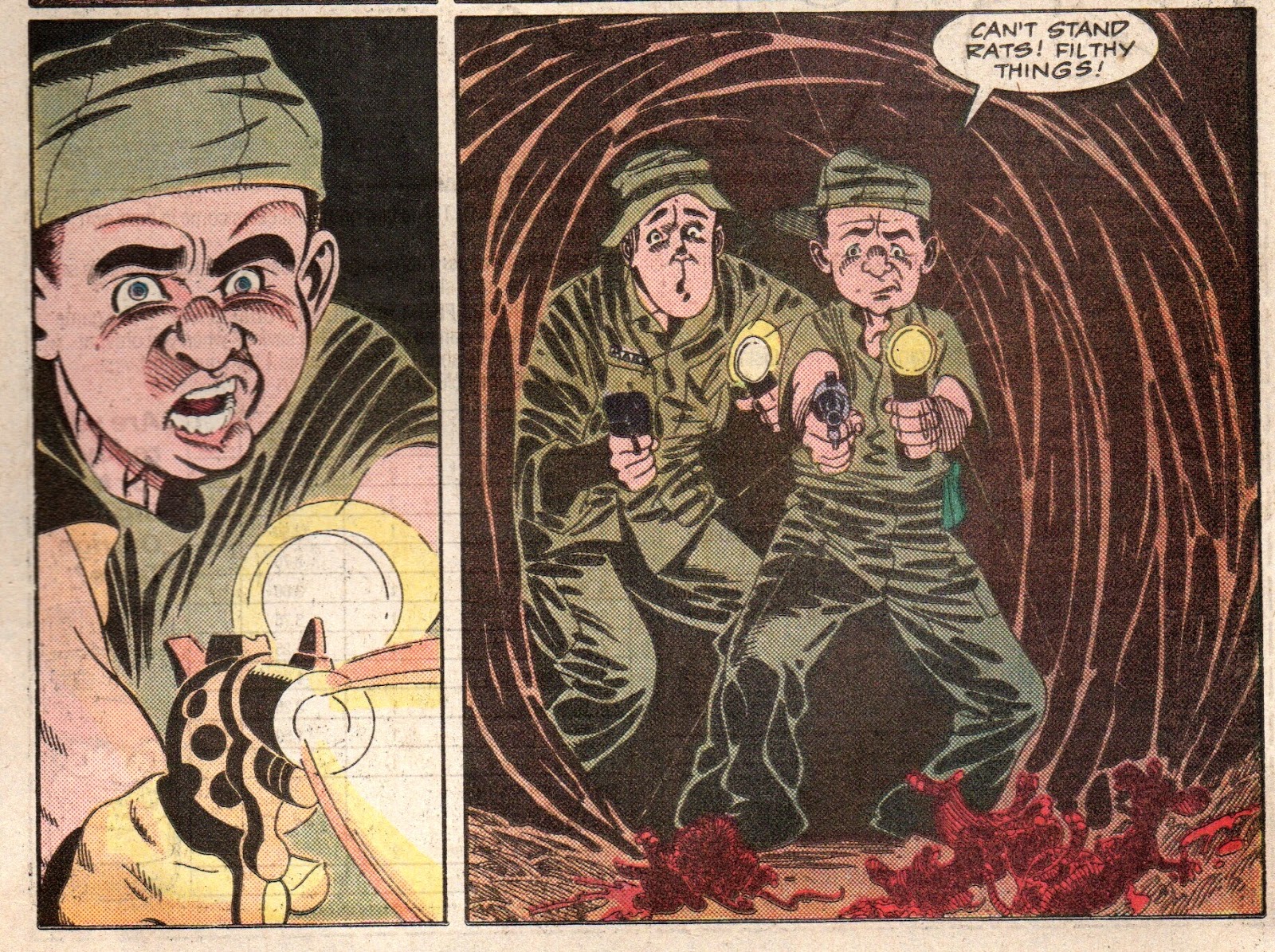
When I think of The 'Nam, I think of the saucer-sized eyes, the backwards cap, the army flashlight and .45 on the front of issue #8 and it scares the fight right out of me. Artist Michael Golden captures the absolute expression of dread and fear on the face of that soldier; it's a chilling look of desperate determination. Golden did the cover art as well as the interiors for the first year the series was in publication. At the start of its run, each issue of The 'Nam was a stand-alone story. The series did not feature cliffhanger endings or follow continuity within the Marvel Universe (or the New Universe, for that matter). Later on in the series (after writer Doug Murray left) in an act of editorial hubris -- and to boost flagging sales -- the Punisher was brought into the series continuity in something called The Punisher Invades The 'Nam. Truth is sometimes stranger than fiction.

The 'Nam #8 follows SP5 Frank Verzyl, a ''tunnel runner'' (later called 'tunnel rats') -- on the letters page of each issue (entitled 'Incoming') Murray includes notes and definitions for terms used in each issue. Since the 1940's, the Viet Cong had been constructing underground complexes that contained hospitals, headquarters, storage facilities and much more. The tunnels were narrow and suffuse with booby traps. It took temerity to build them and balls to go down into them in pursuit of the enemy.

Golden's cartooning is known for its detail and realism, it's reminiscent of Hal Foster, Bill Mauldin and Will Eisner. For the design of Verzyl, Golden comes up with a very cartoonish look; at times, the soldiers in The 'Nam look like the Riverdale gang in olive drab and Verzyl that much more, which is Murray and Golden's point. Verzyl's nose sticks out to me; it looks like a teardrop whereas the noses of the other characters all cut a similar straight line, cartoonish, yes, but Verzyl's schnoz looks more exaggerated by design. By giving Verzyl a more stylized appearance, Golden tempers the tension in the issue. In fact, Verzyl looks a bit like Elmer Fudd (more on that in a moment) a little too on the nose, perhaps, but Golden and Murray's hearts are in the right place.

Snakes have it rough in The 'Nam #8. A big python has its head blown off on the first page and then a poisonous bamboo snake is tricked out of a trap and decapitated -- that's world building in The 'Nam, kill or be killed. Claustrophobics will have a tough enough time with this story, but Murray has to make sure the stakes are set high and the danger is palpable. The tunnel entrance is discovered within the first couple of pages. Verzyl is called in and another soldier, Marty, is sent down first to assist him. Marty makes it one panel before he screams and a bloody mess that was Marty gets pulled out of the hole. Marks and his best friend, Mike, grenade the hole and the threat abates, for now. The NCOs (non-commissioned officers) and the officers confer and ask for another volunteer, Marks steps up and goes down into the tunnels with Verzyl.

Golden never gets flashy with his panel layouts. He divides his pages into five or six panel grids which gives The 'Nam the look and feel of a documentary or a news report -- the US war in Vietnam was, after all, the first war to be broadcast. The larger size panels allow Golden to cram his compositions. Some part -- a boot, an arm, or a head – of Marks or Verzyl always crowds the space he shares with his partner. To further add to these tight quarters, Golden employs several close-ups and gets right up into the faces of the characters, sometimes his focus is so tight, only an eye fills the frame and sometimes it's the booby-trapped belly of a corpse.

Verzyl (at his most Fudd-like) pops out of the ground at the end with his arms raised above his head and says to the four muzzles that cover him: ''American! I'm an American! Apple pie, the World Series, oh, say can you see! Don't shoot'' With the Verzyl and Marks out from the underground, Verzyl tells Marks his time in Vietnam is getting short. He wants to ''re-up and go airborne. Get some extra money and get out of the mud.'' Marks responds with the issue's most poignant and most disturbing line: ''Won't do any good. There's [sic] tunnels all around here. All over the place.'' That's the thing about war, about The 'Nam, success is a fallacy -- there are always more tunnels, missions end; war endures.

What would become The 'Nam began as '5th to the 1st,' which Murray and Golden created and was featured in the short-lived (Oct. 1985 - Dec. 1986) black-and-white Marvel anthology, Savage Tales. Only two of those stories, '1967 ' and 'The Sniper' were published in Savage Tales. '5th to the 1st: The Tunnel Rat' serves as a backup story in The 'Nam #8. Verzyl is again the main character, but the story is presented as a mix of panels and full page illustrations (very similar to Foster's Prince Valiant). There are no word balloons, only text boxes that read as journal entries. The plot is basically the same, an entrance to a tunnel network is discovered and Verzyl is sent in to investigate.

'The Tunnel Rat' has little to none of The 'Nam's sensibilities when it comes to the horrors of war. In many ways, 'The Tunnel Rat' has more in common with Two-Fisted Tales or even Sgt. Rock by way of H.P. Lovecraft and E.A. Poe than it does with The 'Nam. While underground Verzyl is attacked by dozens of rats. Golden draws three widescreen panels and stacks each on top of the other as Verzyl is overrun. The middle panel is askew as the camera zooms in on the Verzyl's terror-filled face. The bottom panel is devoid of emotion or expression; it is solid black and slanted. Golden and Murray know they can't express or show a greater horror than what the reader's imagination will fill-in for that final panel.
 
The rats are bad, but what happens next is worse. Like the undead, Verzyl comes tearing out of the ground. Wild-eyed, he fires his pistol back into the hole he just emerged from and then falls into a fetal position. He's in shock. On the next page, the narrator explains that Verzyl was beginning to pull himself together when a callow lieutenant orders him to go back down into the tunnels. The narrator explains what happens next: ''Fudd did the only thing he could think of -- he pulled his sidearm and shot the LT on the spot.'' The story ends with Verzyl court martialed, strapped to a gurney and put on a transport plane -- ''a raving madman.'' Golden uses three panels to show Verzyl's approach to the plane. The first and second panels look out from the ramp of the C-130, the third panel is from Verzyl's POV as he looks up at, says the narrator: ''the biggest, blackest tunnel mouth you've ever seen.'' Verzyl loses whatever sanity he has left. The final panel is a close-up of his face, a rictus of pain and terror. The narrator says: ''I still hear that screaming sometimes in my head […] sounds kind of stay with you.''

Verzyl's fate is sensational in extremis. The first story, 'In the Underground,' has a higher body count, but because of Murray and Golden's comics-code-friendly approach to the storytelling it feels more sanitized, more of an adventure. 'The Tunnel Rat' has none of that. Perhaps it's Golden's more realistic approach to the art or Murray's use of a third-person narrator that makes 'The Tunnel Rat' feel more like a horror of war rather than a look at the horrors of war. Like Verzyl, it's the cargo bay door that haunts me too, a black maw opening into nothingness and into inescapable madness.

□□□

My own hawkish-ness would subside in the years to come -- four years at a military college gained me both a healthy respect for those who serve and the good sense military service wasn't for me. I've also seen Platoon several times since and, yes, it holds up.

Comic books will always have to push back against those who see them as merely 'comic books,' escapist fare for puerile thirteen-year-olds and neither serious art nor capable of commenting on the human condition. The 'Nam proves otherwise. Its creators use their experiences during wartime to teach a new generation about what it means to be human under extreme and oftentimes absurd conditions.

In the mid-1980's, comic book writers and artists establish a beachhead towards acceptance in popular culture. The Dark Knight Returns and Watchmen provided a kind of cultural clout the mainstream is only catching up to today. The 'Nam isn't as well-known as either of those two other works. It is significant for what a comic book can do and for that alone, The 'Nam should be remembered.

Sunday, September 1, 2013

Dig The Longbox (Redux): Planetary #13

This review of Planetary #13 originally ran on RCB.net for the 'Dig The Longbox' column.
□□□

I quit collecting comics sometime in 1988 and came back at the end of 2011. Oh, sure, I read the odd graphic novel from time to time, but I was not, shall we say, 'active' in the life. Someday, I'm going to write about why comic fans stop reading/collecting and why (or if) they come back. ANYWAY like any traveler returned after a long absence, I was curious to know what I had missed. What were 'the kids' reading -- and dancing to -- these days?

There exists the perverse thrill of watching surprise (indignation?) dawn on the face of (some) fanboys when I admit ignorance as regards Preacher, Ex Machina, The Authority or The Invisibles let alone having not read (much) Ennis, Vaughan, Ellis or Morrison. Anyone who spends lengthy stretches of time in any one particular pop culture hothouse or another too often develops a kind of blindness or myopia to the outside world. I find cinéastes are the worst. I've seen more than a few come down with an acute case of the howling fantods when they hear a confession about never having seen Vivre sa vie, Les quatre cents coups (The 400 Blows), or anything by Antonioni or Lubitsch; so, it's all relative.


Planetary (1999 – 2009) by Warren Ellis, John Cassaday and Laura Martin née DePuy (including a host of different letterers) falls well within my time spent off-world. I'm far from a fully-committed Ellis aficionado. With the exception of Planetary -- of which I've only read a half-a-dozen issues -- I remain unschooled in the majority of the Ellis oeuvre. I would call myself more of an Ellis tourist with the potential to become a raving wild-eyed promulgator should I allow my psychosis to further develop.

At only thirty issues (twenty-seven in series proper) Planetary can be classified as manageable when it comes to the comic book reader's favorite pastime, 'catching up.' Then again, just because you tag along on a docent-led tour of the Vatican doesn't mean you're conversant on the intricacies of the Sistine Chapel; because that's what Planetary is, a masterpiece. To write about such a magnum opus approaches dissecting a snowflake with stove wood.

For all the praise and laurels Planetary receives, I find it remains cultish, on the fringes, which is precisely where it should reside, in secret. Wikipedia away, but know is this: Planetary is about all things great and geeky in the last two millennia. From sci-fi to pulp and from genre-fiction to film, Planetary has it all not to mention it's meta, complicated, deconstructs and reconstructs and abounds with analogues -- a genre comic book about comics and genres, but, so, so much more.

Planetary #13 essentially marks the midpoint in the series. I would be curious to know if it was Ellis's intention to mark this occasion with an exploration into the 'salad days' of protagonist, Elijah Snow, or if it was more organic. As a kind of stand-alone origin intermezzo, Planetary #13 locks into place while it also reinforces the overall narrative. The cover to the penultimate issue confirms this overarching 'puzzle,' each issue apiece of a piece, and part of a greater whole. Origins have origins -- secret histories -- and so Planetary #13 marks Snow's first meeting with a couple of extraordinary gentlemen and explains how Snow got so smart.

A writer with the balls of a Warren Ellis knows comics should read as well with words as without. Perhaps, this knowledge is made easier when one hitches his wagon to the likes of John Cassaday. An artist with a realist style equal parts unfussy and detailed, Cassaday's work is simple to categorize: gorgeous. Perhaps to evoke memory, Cassaday draws each of the panel borders in this issue with rough-edges and (with a few inset exceptions) separate from their neighbors -- the constituent parts of a patchwork quilt. Each page is composed as a complete story and each panel leads the eye from one image to the next. Isn't that what comic books are supposed to do? Rhetorically speaking, yes. But ask yourself: how many pull of the feat? This is what we talk about when we talk about sequential art and John Cassaday is among a very select number of the art form's masters.

What little narration there is at the start of Planetary #13 fits within tidy boxes meant to look like notebook entries. The leaves of this journal are clipped and neat, not torn or frayed. These are the edited musings of a circumspect mind, a man of intellect, the exact opposite of the man who shows up on the page. The turnout may be Tom Wolfe, but Cassaday draws Snow (natty or not) as a bruiser -- short, boxy with wide shoulders and a strong right cross. For all his physical gifts (his physique not to mention the power to freeze things solid), it's Snow's charm, his cranky gentility which makes him memorable and likeable. As he bludgeons a faux-Frankenstein monster with the frozen arm of one of its colleagues, he asks, ''Die or something, would you?'' and then thanks the beast when it obliges. Only a comic as audacious as Planetary would pay off a four-page fight with the line: ''I was only lookin' for the damn library.'' Ah, the charms of Monsieur Ellis, how they juxtapose with Cassaday's gifts for action.


The library belongs to ''the Baron'' although Ellis has enough cheek to let readers figure it out for themselves (hint: see above parargraph). Throughout the issue Snow's thoughts (and dialogue) are sprinkled with other (not so) obtuse references: ''that invisible fella,'' ''a man who went to Mars'' and ''the Frenchman.''  Beasts bested, Snow finds his objective, ''the secret map of the world'' as divined by a group of illuminati who styled themselves, ''the Conspiracy.'' The map leads Snow to a well-known London address on Baker Street. After another display of his Alexander-of-Macedonia-like action-hero-ish nature, Snow has a conversation with the master sleuth so chock-a-block full of conspiracies (some open, some dark and some darker) and secrets (''eugenics'' and a ''controlled economy'') that the entire chummy chat turns quite forgettable. Planetary makes its bones on secrets and some sort of 'dead-drop' gets made every issue.

What makes Planetary #13 memorable is when Snow kicks Dracula and shatters his crotch.

The name 'Dracula' is never said. Why say the name when you can 'count' on Cassaday to sink his teeth into it? The unnamed undead emerges from the shadows (of course) and before Snow administers the ultimate coup de grâce, Snow confirms this is no garden-variety vamp: ''met a lady called Van Helsing in New York city last year.'' As one of Ellis's countrymen once wrote, ''—that is all // Ye know on earth, and all ye need know.''

The ball-busting image of a shattered Dracula serves as graphic shorthand for the phrase: ''that's the issue when …'' It's a one image distillation of the opening sequence, a challenge -- a literal kick in the crotch -- from Ellis and Cassaday to their fellow writers and artists (and by extension to every reader) to remember: comic books are a visual medium, don't forget it.
 
I'll pass along the advice I received when I wanted to 'catch up' on Planetary: don't read it in trade, sample a couple of singles first and then buy the trades, if you must. Every issue of Planetary stands on its own, has its own orbit you might say. If you like one you're apt to like each and every thrilling adventure. Odd, nowadays, I know, a comic book series that reads as well in singles as it does collected. As Snow is fond of saying: ''It's a strange world. Let's keep it that way.'' Dig it?