Unfortunately, all of my columns were lost to the ether when the site went off line. Which means in order to (re)post them here I give myself the gift of tightening up, fixing and over all revising. Bliss. There's an old saw I like about how all(?) writing projects are never finished only abandoned. That sounds harsh, far from it. I like to think about my writing like a newspaper, a new edition comes out everyday. They still print newspapers, right? Vive la' Longbox!
□□□
 Cerebus the Aardvark
carries weight. Not only does the series run three hundred issues -- the entirety
of which is collected in sixteen trade paperbacks or 'phonebooks' if one is in
the know -- it is also one the most influential comic books of the the past thirty years in terms of independent publishing and creator rights.
Cerebus the Aardvark
carries weight. Not only does the series run three hundred issues -- the entirety
of which is collected in sixteen trade paperbacks or 'phonebooks' if one is in
the know -- it is also one the most influential comic books of the the past thirty years in terms of independent publishing and creator rights.
The paterfamilias
of this tale about Conan if said barbarian was an 'earth-pig' is Canadian cartoonist
Dave Sim. To describe Sim, the man, as idiosyncratic misses much of the mark. From
his creation of Cerebus in 1977 until
the series conclusion in 2004, Sim goes from indie comics Godhead to industry
pariah. Sim's sin is to use his own self-financed self-published comic to air
extremely misogynist opinions
(which he self-styles as 'anti-feminism') through a minor character,
Viktor Davis, in Cerebus #186.

I have written about Sim, fandom and Cerebus #186 at length
andeven though I do not self-identify as a Cerebus
fanatic -- and the farthest thing from a Sim apologist natch -- I am
surprised (and saddened) at how few fans of comic books have read an issue of Cerebus let alone appreciate the impact
it continues to have on the industry today. The success of publishers
like Image and Dark Horse and the rise of more and more creator-owned titles
every month is due, in part, to Sim and Cerebus.
No joke.
Set aside Cerebus's
influence, Sim's troublesome personal politics (if possible) and the anxiety
inherent in having to even consider reading a three hundred issue
black-and-white comic and treat Cerebus
the Aardvark the same way an alpinist assents Annapurna: start with an established
base camp. For most this means The Regency, the hotel at the center of the series's
best known story arc, ''High Society.''
When I write about Cerebus
I feel as though I must keep apologizing for my own embellishment. Not when
it comes to ''High Society.'' The story surrounding the circumstances, coincidences and dumb luck of
how Cerebus goes from itinerant (and smelly) barbarian to Prime Minister are examples of what all writers, cartoonists and storytellers should aspire to
create … every time. ''High Society'' ranks with ''Symphony No. 9,''
''8 ½'' and ''The Sound and the Fury'' as far as the best of the best. See what
I mean? Hyperbole, but not.
 Cerebus #32 is the
seventh in the twenty-five issue story arc (#26 - #50) that comprises ''High
Society.'' As with many works of high art, this issue begins with a classic problem:
money, specifically debt. The (sort of) quick recap goes like this: the
financial 'wolves' are at Cerebus's door. He owes the state
the ransom they paid when he was kidnapped (Cerebus #27). Cerebus staged the kidnapping himself, of course. In turn, the state owes
money to Holland M. Hadden of Hadden, Hadden and Dipp. The Prime Minister tells
Cerebus if he can persuade Hadden to waive the government's debt than the Prime
Minister will do the same for Cerebus.
Cerebus #32 is the
seventh in the twenty-five issue story arc (#26 - #50) that comprises ''High
Society.'' As with many works of high art, this issue begins with a classic problem:
money, specifically debt. The (sort of) quick recap goes like this: the
financial 'wolves' are at Cerebus's door. He owes the state
the ransom they paid when he was kidnapped (Cerebus #27). Cerebus staged the kidnapping himself, of course. In turn, the state owes
money to Holland M. Hadden of Hadden, Hadden and Dipp. The Prime Minister tells
Cerebus if he can persuade Hadden to waive the government's debt than the Prime
Minister will do the same for Cerebus.
After several snifters of whiskey, Cerebus suggests Hadden's
proposal for gold-plated streetlamps should be amended to solid gold street
lamps (!). Recognizing solid gold government contracts don't come around every day
Hadden agrees to waive the debt and Cerebus promises to talk to the Prime
Minister about the streetlamps. So, yeah, total scam.
However, before Cerebus can collect, Hadden is pulverized by a giant crescent moon made of stone -- the preferred weapon of the Moon Roach -- which flattens him like a pancake. No money, no contract and now Cerebus has to answer for a dead Hadden and a costumed vigilante who declares 'unorthodox economic revenge.' Cerebus #32 starts with the added threat that should Cerebus default, the Prime Minister will ''throw [him] to the inquisition.'' And as we all know nobody wants (or expects) an inquisition, Spanish or otherwise.
All of these events are summed up (faster, better) by one of
''High Society's'' favorite characters, the 'Regency Elf,' a Tinker Bell-like
fairy … err, elf who lives in the Regency (hence her name) and who acts as
Cerebus's girl Friday. To get out of his money problems the elf suggests
Cerebus ''try the truth'' to which Cerebus (who always speaks in the third-person) replies: ''Cerebus needs something more effective.''
Later on in the issue after Cerebus loses his temper with the elf, he receives
a package from Edmonds, Lord Francis. Cerebus sniffs out the set-up and burns the package which leads to a contact high kind of a gag that would make Cheech & Chong proud. One
panel later the 'Holy Order of Moral Inquisitors' shows up at Cerebus's door to
investigate an anonymous tip they received about ''five kilograms of illicit narcotics'' on the premises. The moral of
the story: never accept a gift from someone with a comma in their name and never make
an elf mad.
Pause. So, yes, Cerebus is extremely
episodic and complicated with lots of characters and not all of them parodies.
And, yes, ''High Society'' is best read in trade. Sim levels up
(stratospherically) with this arc through the use of political and religious satire,
inside industry jokes (Moon Roach is one of many such shots Sim takes at corporate
comics) and the kind of cartooning which riffs on the rules and rewrites them
at the same time.
Sim is a comic book geek's geek. Before Cerebus, he submits articles and artwork to fanzines, writes
and creates newsletters about comics, Sim's devotion goes so deep, he quits school
(after failing to finish the 11th grade) and commits to cartooning
full-time. From his page layouts and panels -- all of which bear little or no resemblance
to mainstream American comics from the late 1970's and '80's -- it's clear Sim is
more than fan, he's an acolyte, a devotee and a straight-up madman.
 At this point in the series Sim was doing all of the art --
starting with issue #65, Sim hires on the one-name wonder, Gerhard, to draw
backgrounds for the remainder of the series -- so Cerebus's room often looks like a black void, an appropriate
metaphor for backroom politics to be sure. Despite their lack of depth Sim's panel
and page layouts are forever eye-catching and forward-thinking. He understands
the less is more approach sacrifices nothing and, in fact,
enhances creativity to open doors to all sorts of possibilities, most
figurative, some literal.
At this point in the series Sim was doing all of the art --
starting with issue #65, Sim hires on the one-name wonder, Gerhard, to draw
backgrounds for the remainder of the series -- so Cerebus's room often looks like a black void, an appropriate
metaphor for backroom politics to be sure. Despite their lack of depth Sim's panel
and page layouts are forever eye-catching and forward-thinking. He understands
the less is more approach sacrifices nothing and, in fact,
enhances creativity to open doors to all sorts of possibilities, most
figurative, some literal.Un-pause. From its cover to its plot Cerebus the Aardvark #32 centers on one thing: money, money, money. Cerebus wants it and it's the character of Astoria who makes sure Cerebus is paid and paid and paid. While Cerebus is holding back his creditors, Astoria and Moon Roach -- whose alter ego's alter ego (something like that) is Astoria's boyfriend, Artemis -- have snuck into his room. Astoria solves Cerebus's debt problem by instructing him to authorize a three percent increase on tariffs and then promises to make him ''an embarrassingly wealthy aardvark.'' To put it in 'Breaking Bad' terms, Astoria becomes Lydia to Cerebus's Walter.
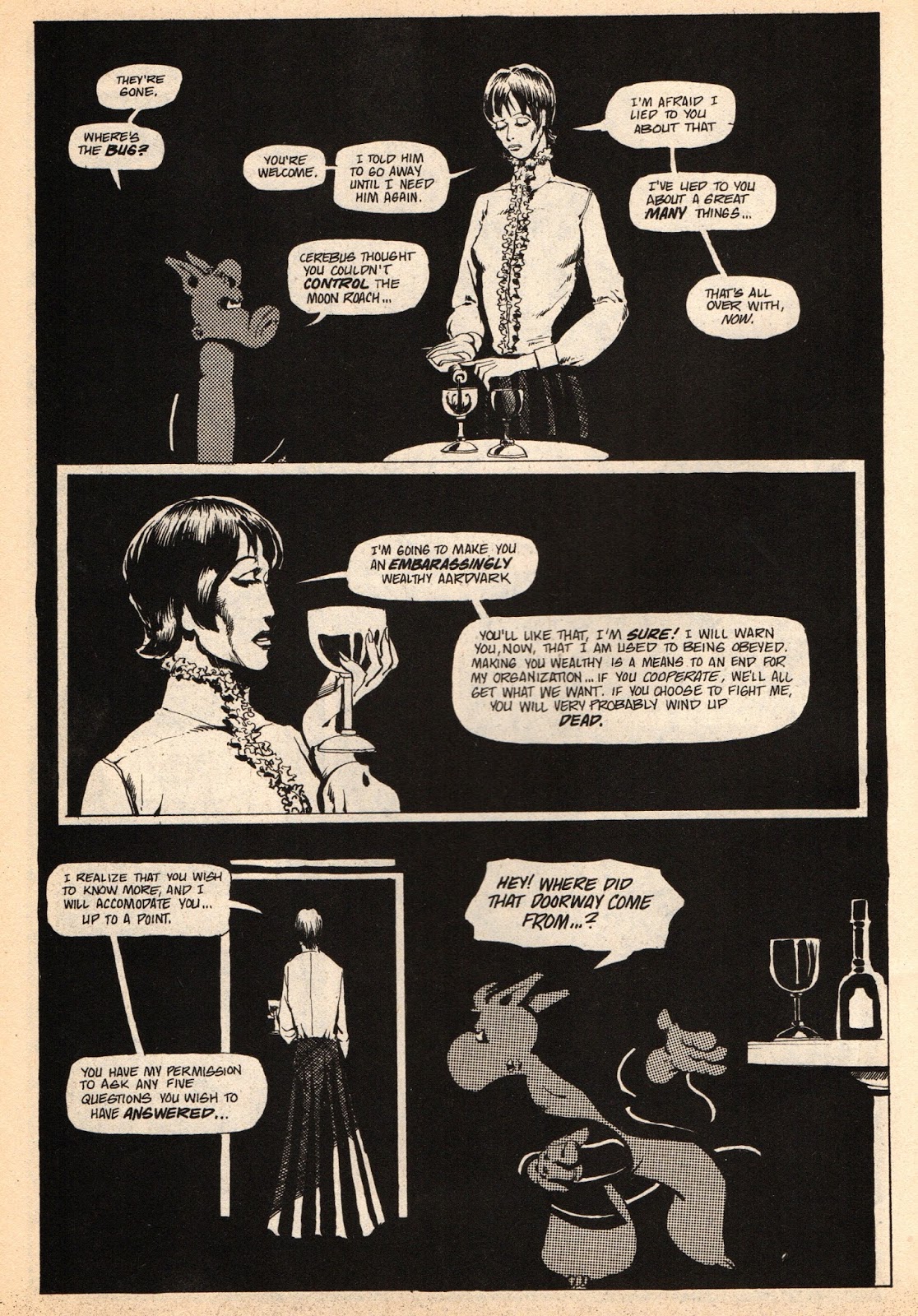 After Astoria makes Cerebus an offer he can't (and she knows
he won't) refuse, she exits through a secret door. With
her back turned to him, Cerebus stands-in for the reader: ''Hey! Where did that doorway come from …?''
The idea of an antechamber hidden within the paneling of Cerebus's own room
(his own comic!) is as ingenious as it is poetic -- an 'emptiness' that
creates more (much more) from less.
After Astoria makes Cerebus an offer he can't (and she knows
he won't) refuse, she exits through a secret door. With
her back turned to him, Cerebus stands-in for the reader: ''Hey! Where did that doorway come from …?''
The idea of an antechamber hidden within the paneling of Cerebus's own room
(his own comic!) is as ingenious as it is poetic -- an 'emptiness' that
creates more (much more) from less.
To quote another ''self-reliant'' creator,
''a foolish consistency [or continuity] is the hobgoblin of little minds. There
are always doorways in (and out) of every long-running epic and all of them
either almost always appear from nowhere or only open once the reader takes
the time to look for them. To read Cerebus
is tall order (and at times tough sledding). I admit, I may have created a
problem where there wasn't one; how Cerebus, how Sim (?) of me. Read Cerebus because there has never been
anything like it, anywhere, ever. Words like 'innovative' or 'one-of-a-kind'
don't do Cerebus justice, trust me
and yield to the Earth-pig. You dig?


