 This week marks the
beginning of the Major League Baseball season. Which along with starting a
rumor about the coming of summer here in the Northeast, reminds me of a great apocryphal
story (great word that, apocryphal) about that handmaiden of sports,
statistics. Story goes like this: during the off-season successful slugger goes
to see management about a new contract. Said slugger says he batted .315 this
past season (roughly three hits for every ten at bats, well above the league
average). The general manager smiles and says, ‘yeah, slugger, but you only got
a hit three times out of ten. What about the other seven times you went to the
plate?' Baseball, of course, is the only profession you can fail at seven out
of ten times and still be considered for the 'Hall of Fame.' Statistics can be
counted on, but the devil is always in the details, the context. Blogger's stat
tracker tells me that the post for my review of Spaceman #4 has been viewed one-hundred-and-seventy-six times since
I posted it on March 3rd. I would tag that a moderate success and
yes (you glass-house-living-throwers-of-rocks) I have set Blogger so that it
does not track my own page views.
This week marks the
beginning of the Major League Baseball season. Which along with starting a
rumor about the coming of summer here in the Northeast, reminds me of a great apocryphal
story (great word that, apocryphal) about that handmaiden of sports,
statistics. Story goes like this: during the off-season successful slugger goes
to see management about a new contract. Said slugger says he batted .315 this
past season (roughly three hits for every ten at bats, well above the league
average). The general manager smiles and says, ‘yeah, slugger, but you only got
a hit three times out of ten. What about the other seven times you went to the
plate?' Baseball, of course, is the only profession you can fail at seven out
of ten times and still be considered for the 'Hall of Fame.' Statistics can be
counted on, but the devil is always in the details, the context. Blogger's stat
tracker tells me that the post for my review of Spaceman #4 has been viewed one-hundred-and-seventy-six times since
I posted it on March 3rd. I would tag that a moderate success and
yes (you glass-house-living-throwers-of-rocks) I have set Blogger so that it
does not track my own page views.
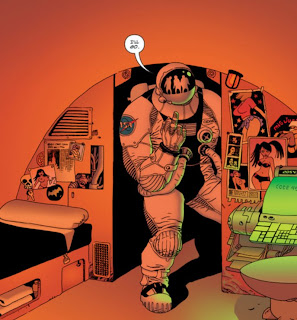
My writing about Spaceman #4 is what got me the gig at
Comics Bulletin, so, at least, somebody liked it, right? I guess all that
matters is that I think I have something to contribute to the critical
conversation about Spaceman. I'll
admit that I can understand how this is a tricky series to navigate either because
of its pidgin futurespeak, or its monkey-man-meets-noir-dystopia-sci-fi, or,
even, the audience's own 'anxiety of influence' because this is Brian Azzarello
and Eduardo Risso's follow-up series to 100
Bullets. As I often ask: So what?
After I wrote my
series review of The Strange Talent of
Luther Strode, I emailed it to a few bloggers I’ve gotten to know (I believe) fairly
well. Their feedback was very helpful. The
one theme that emerged from their feedback was, 'I'm not reading this series,
so, why should I care about it?' A 'so
what?' in so many words. As much as I love Azzarello's gloss on language and
celebrity culture, it's all academic wankery if the characters are underdeveloped
and the plot is hackneyed and overcooked. Writing is a solitary pursuit, but
editing and proofreading often turns into a team sport. To Martin, Owen, Justin
and Seth here is (I hope) proof that I listened. Thanks to Jason and Danny at Comics Bulletin
for making this process easy and worthwhile. Instead of braining you, constant
reader, with the beginning of the piece let me hit you upside with the end:
''Azzarello makes it
easy to get stuck in Spaceman's semantic
stew of words and the meaninglessness of meaning. Geeking out on words only gets
one so far -- and if one wants more, they have schools for that sort of thing.
What makes this story work is spaceman, is Orson. There is a ''knight-in-shining-armor''
quality to Orson that should not be given short shrift. The reader roots for
Orson and wants to see him bring Tara home safe, but it's a question of can he
rather than will he. A man of some means, a certain survivor, Orson is also out
of place, out of his world and out of his depth. When Orson first brings Tara
to his place, he says, ''I promd to keep
you safe … but … we don know what
that means jus now. Home might not
be safe.'' Like many a traveler,
many a spaceman, Orson wants to go home, but what is home to a space man? Spaceman has flown half of its arc, all
that remains is a return. Azzarello and Risso will determine how safe of a
journey it will be and if their spaceman can ever find his way home.''
 Glossed
in Space
Glossed
in Space
Brian Azzarello
grounds Spaceman in language and the
slipperiness of speech. The alien argot
Azzarello imagines occurs out loud; and each one of Eduardo Risso’s panels
balloon with words, drunk on overlapping dialogue boxes; narrators in no need
of narration. In other words, Spaceman is one wordy ‘mo-foco,’ as the
kids say.
Half the fun of Spaceman is learning to speak the
language and getting caught in the sticky web of words that Azzarello weaves
into his low-down dirty story of kidnapping, celebrity culture, and genetically
engineered workaday spacemen. This tale,
however, is not a mere gloss on glossolalia nor is it interested in inventing
language for the sake of invention or, for that matter, for the sake of
language. What Azzarello and Risso
create is a dialogue of binaries: public and private, perception and reality, words
and pictures, haves and have-nots.
Amidst these opposites exists the spaceman, Orson, a cast-off, caught
between worlds, floating through space.
Spaceman #4 is an interstitial episode, that’s not to say that
nothing happens, although not much does: plans are made, investigations go on,
and new schemes are schemed. This is a
series that rewards being read backwards as well as forwards; words and phrases
easily missed in previous issues the first time through yield treasure on a
second or third pass.
For example, the
word ‘gold’ appears in two different scenes in this issue, each time the word
means something different; ‘gold’ has a different value depending on means and on
information. ‘Gold. Holee Fuck. Gold,’ says a headset-wearing
someone lording over a bank of monitors.
In this instance ‘gold’ is an expression referring to prized moment. The cameras of ‘The Ark’ (a reality TV show
or ‘cast’) catch the parents of the kidnapped girl, Tara, reacting to being
told that they are suspects in the police investigation of the crime. The father, Marc, pleads with his wife,
April, saying: ‘that playing Tara’s kidnapping out in public – it’s nobody’s
business but ours.’ A private matter
played out in public becomes a ‘golden moment’ broadcast in the binary code of
ones and zeroes. In the world of Spaceman, words and information are coin
of the realm, but only if one has means.
The other time the
word ‘gold’ is used is when the four spacemen are staring at a pile of it that they
have liberated from the Martian surface.
This kind of gold, real gold, is worth less than information, it has no value because as Orson says to his
fellow spacemen, ‘We here – so’s it.
Gold be fuckin dust to us.’
What’s the value of ‘gold’ if there’s no profit to be made? No means
means no. This is only one example of dozens throughout
the series (hell, in the course of this issue) when the elusiveness of meaning
is made plain.
Orson is a scavenger,
although ‘salvager,’ is probably a better description of our ‘humble narrator;’
a creature of his environment. It’s no
accident that Orson ‘saves’ Tara or that his speech is a stew of infectious
idioms. Orson like language adapts. As the two head towards their next dead end, Tara
tells Orson, ‘I think this is cool’ and then corrects herself, ‘I mean I brain
– I brain this is cool …’ In the final
analysis Orson and Tara’s survival depends on if they can adapt or is it all
talk. You brain me?
 This week marks the
beginning of the Major League Baseball season. Which along with starting a
rumor about the coming of summer here in the Northeast, reminds me of a great apocryphal
story (great word that, apocryphal) about that handmaiden of sports,
statistics. Story goes like this: during the off-season successful slugger goes
to see management about a new contract. Said slugger says he batted .315 this
past season (roughly three hits for every ten at bats, well above the league
average). The general manager smiles and says, ‘yeah, slugger, but you only got
a hit three times out of ten. What about the other seven times you went to the
plate?' Baseball, of course, is the only profession you can fail at seven out
of ten times and still be considered for the 'Hall of Fame.' Statistics can be
counted on, but the devil is always in the details, the context. Blogger's stat
tracker tells me that the post for my review of Spaceman #4 has been viewed one-hundred-and-seventy-six times since
I posted it on March 3rd. I would tag that a moderate success and
yes (you glass-house-living-throwers-of-rocks) I have set Blogger so that it
does not track my own page views.
This week marks the
beginning of the Major League Baseball season. Which along with starting a
rumor about the coming of summer here in the Northeast, reminds me of a great apocryphal
story (great word that, apocryphal) about that handmaiden of sports,
statistics. Story goes like this: during the off-season successful slugger goes
to see management about a new contract. Said slugger says he batted .315 this
past season (roughly three hits for every ten at bats, well above the league
average). The general manager smiles and says, ‘yeah, slugger, but you only got
a hit three times out of ten. What about the other seven times you went to the
plate?' Baseball, of course, is the only profession you can fail at seven out
of ten times and still be considered for the 'Hall of Fame.' Statistics can be
counted on, but the devil is always in the details, the context. Blogger's stat
tracker tells me that the post for my review of Spaceman #4 has been viewed one-hundred-and-seventy-six times since
I posted it on March 3rd. I would tag that a moderate success and
yes (you glass-house-living-throwers-of-rocks) I have set Blogger so that it
does not track my own page views.

